
MODERN
MODERN: Modeling Cooperation Between MicroRNA Binding Sites
MicroRNAs (miRNAs) are small non-coding RNAs that associate with Argonaute (AGO) proteins to repress gene expression, primarily through binding to the 3′ untranslated regions (3′UTRs) of target messenger RNAs (mRNAs). A single mRNA may contain multiple binding sites for one or more miRNAs. When these sites are located in proximity, their repressive effects may be mutually enhanced through a mechanism of functional cooperativity that remains poorly understood at the transcriptome-wide level.
The team recently developed optiCLIP (Serra et al., 2021, Nucleic Acids Research), a computational pipeline validated using AGO CLIP-seq and transcriptomic datasets to better characterize the biochemical determinants of miRNA-mediated repression. The team has since generated a miR-21-specific AGO CLIP-seq dataset in human hepatocytes under both control and knockdown conditions, coupled with RNA-seq data that enable quantitative assessment of target mRNA repression.
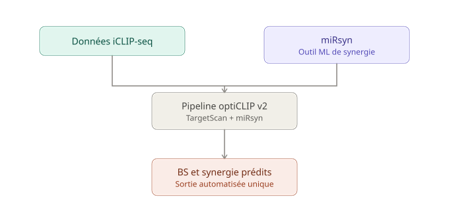
Building on these CLIP-seq and RNA-seq datasets, the team also developed miRsyn, a machine learning–based computational method that identifies miRNA binding sites likely to act synergistically and functionally classifies these sites according to their contribution to target mRNA repression.
The MODERN project aims to integrate optiCLIP and miRsyn into a single automated pipeline, providing the scientific community with a comprehensive framework for the identification, biochemical characterization, and functional evaluation of miRNA binding sites.
Project Leader
Project Participants
Carole BELLIARDO, Center of Modeling, Simulation and Interactions - MSI, Université Côte d'Azur.