
COMICS
Glioblastoma and Cortico-Endothelial Assembloid CELF2 InteractOMICS
Glioblastoma (GBM) is the most aggressive primary brain tumor and remains associated with a dismal prognosis, driven largely by profound therapeutic resistance and the near-inevitable recurrence of the disease. This therapeutic failure is driven in part by the remarkable functional intra-tumoral heterogeneity of GBM, in which tumor cells coexist in distinct differentiation states and transcriptional programs and interact differently with the surrounding microenvironment. Understanding the mechanisms that control this cellular plasticity and sustain aggressive tumor states is therefore essential for the development of new therapeutic strategies.To better recapitulate this complexity, we developed a human cerebral cortico-endothelial organoid model incorporating patient-derived glioblastoma stem cells (GSCs). This three-dimensional brain-like system enables the study of tumor cells within a complex neural environment and provides a model to investigate cellular heterogeneity and interactions between GBM cells and the different components of the tumor microenvironment.
Our work identifies the RNA binding protein CELF2, as a key regulator of the stem-like and aggressive phenotype of GBM cells. CELF2-expressing GBM cells display a strong neuronal identity and preferentially interact with the neuronal compartment. In contrast, CELF2 loss is associated with a reduction in stemness-associated programs and a shift in tumor cell tropism from the neuronal toward the endothelial compartment. CELF2-negative cells acquire mesenchymal features and show reduced tumorigenic potential, suggesting that CELF2 contributes to maintaining an aggressive tumor state adapted to the neuronal niche.
We further performed single-cell RNA sequencing (scRNA-seq) of this model to characterize the different cellular states and dissect the molecular crosstalk between tumor cells and the surrounding microenvironment. This approach provides a high-resolution view of the transcriptional programs associated with tumor cell plasticity and enables the identification of cellular interactions that may contribute to the maintenance or reprogramming of specific tumor phenotypes.
Overall, this project establishes an innovative experimental model to investigate GBM heterogeneity and plasticity within a complex brain microenvironment. It highlights CELF2 as an important regulator of an aggressive tumor state and of GBM cell interactions with the neuronal niche. Ultimately, understanding the molecular mechanisms governing these tumor–microenvironment interactions may provide new opportunities to target aggressive tumor states and develop therapeutic strategies aimed at limiting GBM plasticity and adaptation to its microenvironment.
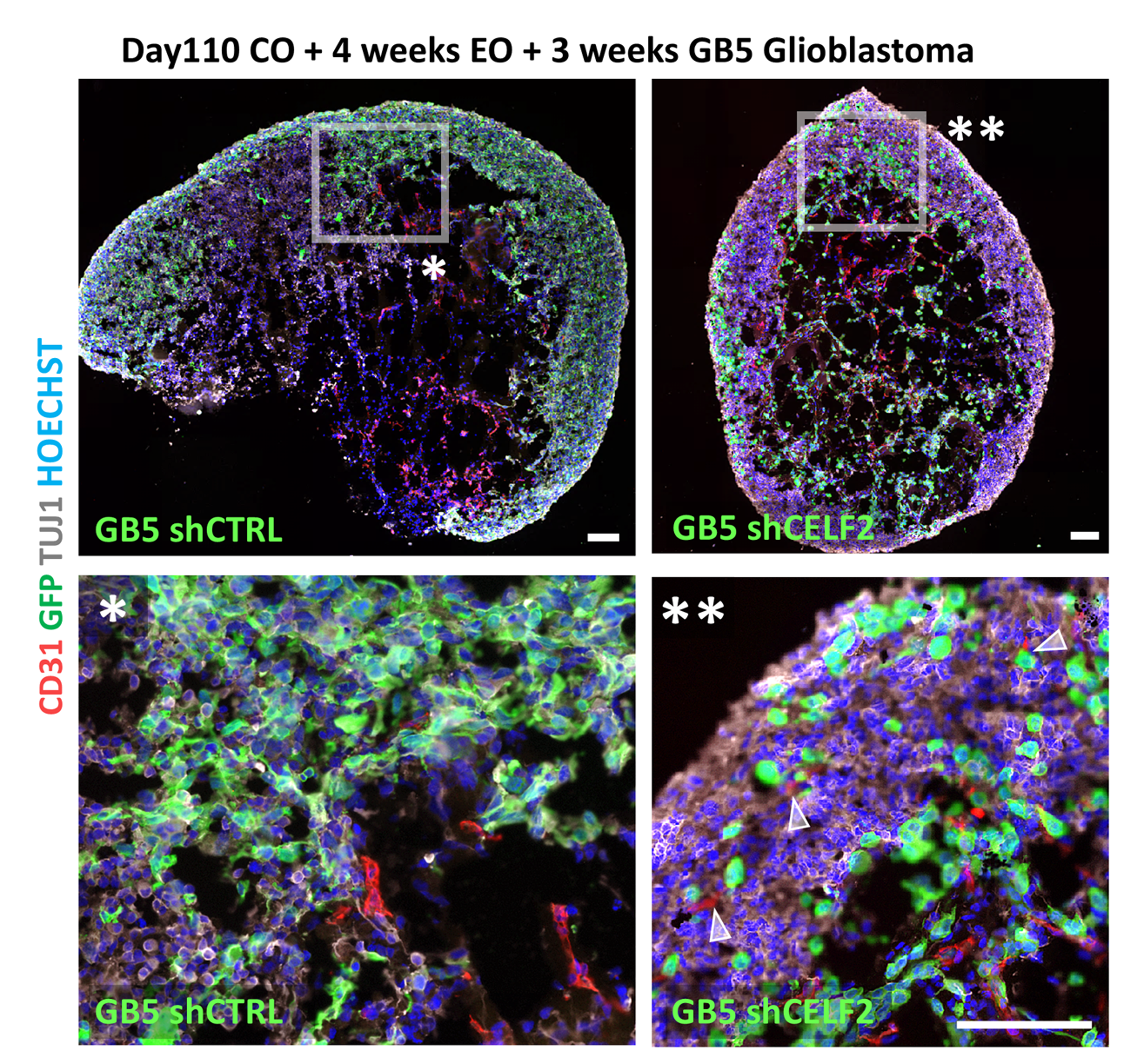
CELF2 controls the tropism of GBM cells within human cortico-endothelial assembloids. We developed human cortico-endothelial assembloids combining cortical and endothelial tissues with patient-derived glioblastoma stem cells (GB5), providing a three-dimensional model to investigate tumor cell heterogeneity and interactions with the brain microenvironment.
Control GBM cells preferentially colonize the cortical/neural compartment, whereas loss of CELF2 markedly redirects GBM cells toward the endothelial compartment.
As illustrated by the CD31/TUJ1/GFP staining, CELF2-deprived GBM cells closely associate with CD31-positive vessel-like structures and migrate along or elongate along endothelial cells, highlighting a striking change in tumor cell–microenvironment interaction.
These findings identify CELF2 as a key determinant of GBM cell identity and spatial tropism within the brain microenvironment.
Project Leader
Thierry Virolle. INSERM Research Director, INSERM Team Director at Valrose Biology Institute (iBV), Université Côte d'Azur.
Project Participants
- Alexa Saliou. Post-doc, Virolle Team, iBV.
- Gwendoline Maharaux. CNRS Engineer, Virolle Team, iBV.
- Laurent Turchi. Research Engineer, CHU de Nice, Virolle Team, iBV.
- Béatrice Polo. INSERM Assistant Engineer, Virolle Team, iBV.
- Michele Bertacchi. INSERM Researcher, Studer Team, iBV.
- Carole Belliardo. Research Engineer, MSI - Center of Modeling, Simulation and Interactions (MSI), Université Côte d'Azur.